
Understanding Cleveland County Releases
A release is the end of one agency's custody event. It is not always freedom from all custody. The F. DeWayne Beggs Detention Center holds people awaiting court, serving local time, waiting for transport, or held for another authority. When the jail completes a bond release, time-served release, dismissal, sentence completion, or other authorized discharge, the name usually falls outside the public portal's current filter. The sheriff's booking and release transaction remains the direct record of that physical handoff.
Cleveland County creates an unusual source of confusion. The county jail in Norman shares the county with the Lexington Assessment and Reception Center and Joseph Harp Correctional Center, both run by the Oklahoma Department of Corrections. A person can disappear from the county roster, arrive at LARC, and remain incarcerated without ever leaving Cleveland County. Municipal arrests add another branch because Norman, Moore, or another city may release a person through a city process or deliver the person to Beggs. The last custodian and receiving agency control which record proves what happened.
A missing CCSO roster result does not prove community release. It can reflect release, transfer, delay, spelling error, or the absence of a county booking.
Cleveland County Release Types
The word "released" has several meanings in Cleveland County records. A bond or recognizance release ends jail custody while the criminal case continues. Time served or sentence completion ties the exit to a sentence, though the court order and jail transaction may carry different times. A dismissal or acquittal ends the relevant prosecution, but another case, warrant, or detainer can keep the person held. Probation, a suspended term, and parole all may place a person outside a secure facility while legal supervision remains active.
| Release path | What it means | Best next record |
|---|---|---|
| Bond or recognizance | County jail custody ends while charges can remain pending. | CCSO release transaction and court bond order |
| Time served or completion | The authorized local term has ended. | Judgment, jail credit, and date or manner of discharge |
| Probation or parole | Physical confinement may end, but supervision continues. | ODOC status and Norman supervision office |
| Transfer | Custody continues with ODOC, another jail, or another authority. | Receiving agency admission or locator |
| Detainer release | One custodian hands the person to an agency with a hold. | Receiving county, federal, or immigration record |
- Discharge
- The formal end of the relevant custody or supervision status.
- Detainer
- A request or hold that may require transfer to another authority.
- Time served
- Credit and custody already completed satisfy the ordered local confinement.
- Parole
- Conditional release from prison while the sentence remains under supervision.
Note: A transfer ends one Cleveland County custody event but begins another agency's custody instead of community release.
Cleveland County Release Record Fields
The most useful CCSO record joins the booking to the final custody transaction. Request the existing jail register, booking record, or release record rather than asking staff to create an explanation. Include the full legal name, date of birth if known, approximate booking range, and any booking or court number. Not every field is always public, and the exact county form is not indexed online. A narrow request still gives the records custodian a clear target.
| Field | What it can establish |
|---|---|
| Name, aliases, birth date | Identity match beyond a common name |
| Booking number and date | The specific Cleveland County custody event |
| Arresting and committing authority | Which agency began or ordered custody |
| Charges and court number | The case linked to that booking, subject to later changes |
| Release date and time | When CCSO ended physical custody |
| Release method or authority | Bond, order, time served, transfer, or another recorded basis |
| Receiving agency or detainer | Whether another custodian took control |
| Booking photograph | The image tied to that booking, if maintained and releasable |
A court docket and jail release record answer different questions. The docket can show the legal order, bond, dismissal, plea, sentence, credit, revocation, or recalled warrant. The jail record shows the gate transaction. If an order is entered before paperwork reaches CCSO, the two times can differ without conflict. Multiple open cases must also be checked because one dismissal may leave another hold intact.
Request Cleveland County Release Records
The CCSO Public Records and Media Inquiries office accepts focused requests at ccsorecords@clevelandcountyok.com. Oklahoma law supports asking for the jail-register information that is kept, including the date or manner of discharge. Electronic delivery and a cost estimate can reduce surprises. CCSO states that ordinary report copies cost $5 and are free to crime victims, but that price must not be treated as the guaranteed cost of every booking packet, photo, video, or broad search.
- Identify the person with a full name, birth date if known, booking number, and a narrow date range.
- Ask for the jail-register and booking or release record, including admission time, date and manner of discharge, release type, releasing authority, destination agency, and public booking photo.
- Request electronic copies and ask for a cost estimate before chargeable work begins.
- If part is exempt, ask for the segregable, nonexempt portion and the legal basis for any withheld material.
- Compare the response with the court order and any receiving-agency record.
2600 W. Franklin Road
Norman, OK 73069-8012
405-701-8888
Monday through Friday, 8 a.m. to 5 p.m.
The public roster has no released archive or stated retention window. Older proof may come from CCSO's files, the Court Clerk, or ODOC Closed Records. The Cleveland County Court Clerk can supply docket materials and certified copies, with its own published fees and completion target. A sealed or expunged record may be intentionally absent from public interfaces, so the lack of an online result should not be turned into a claim that no prior event occurred.
Note: Ask for an existing record and a cost estimate; CCSO does not promise one flat price for every release packet.
Oklahoma Law on Release Records
The Oklahoma Open Records Act, 51 O.S. §24A.8, identifies jail-register or booking information available for public access if the agency keeps it. The listed information includes a prisoner's name, the date and cause of commitment, the committing authority, descriptive information, and the date or manner of discharge or escape. Section 24A.5 permits reasonable direct-copy costs and search fees only under its stated conditions. The law does not impose one universal response deadline for every request.
Access still has boundaries. Juvenile, medical, victim-sensitive, investigative, sealed, expunged, and other exempt information can be withheld or redacted when the law applies. A release entry is not a finding of guilt, and the booking charge may not reflect the final disposition. Under 22 O.S. §18, a qualifying court order can seal covered arrest and court records. A 991(c) deferred-sentence update changes the disposition wording but does not itself erase the arrest record. Precise claims require the final court record.
Three Cleveland County Release Records
One local arrest can leave records in three places. CCSO keeps the booking and physical release transaction. A municipal court can keep an ordinance case, while Cleveland County District Court and OSCN hold state-charge proceedings. The Court Clerk reports computerized criminal cases from 1989 and older written docket books, so the clerk becomes vital when an old release has vanished from online tools.
Follow the charge path rather than choosing one court by habit. Norman Municipal Court handles city-ordinance misdemeanor matters and is not a court of record. State misdemeanors and felonies go to district court. A person transported from Norman or Moore to Beggs can therefore have a city or district case plus a separate sheriff custody record. Neither source replaces the other.
Note: A court order states legal authority, while the sheriff record supplies the physical release or transfer transaction.
When Cleveland County Releases Happen
A judge's order or a paid bond is not the same as the moment a person exits the jail. The CCSO detention FAQ says normal processing takes one to three hours after release paperwork reaches the jail, unless an unusual condition causes more delay. Cleveland County publishes no fixed daily release hour, exit door, family waiting rule, or weekend schedule. The safe course is to confirm with the detention center instead of assuming that an order produces an immediate exit.
Cash bonds are accepted at the detention center and require exact cash because the jail does not make change. That is a local payment fact, not a promise that every case qualifies for bond or that release will follow on a fixed clock. Court authority, other cases, warrants, detainers, paperwork, and identity checks can affect the path. The actual release time belongs in the jail transaction.
Note: CCSO's processing estimate begins when release paperwork reaches the jail, not when a judge signs an order.
Cleveland County Property After Release
Routine clothing, a wallet, and other personal effects handled at normal release should not be confused with the Sheriff's separate Property Custody process. The CCSO Property and Evidence unit uses appointments for evidence or safekeeping property. It may require valid photo identification and proof of legal authority. Its posted policy also warns that safekeeping property can face disposal after 90 days. The unit's appointment number is 405-701-7743.
A person who left the jail without a specific item should first ask whether the item was routine inmate property, safekeeping property, evidence, or held by another arresting agency. That label determines who can release it and what proof is required. If Norman or Moore police made the arrest, property may belong to the municipal agency even when the adult detainee later entered Beggs.
Find a Released Cleveland County Inmate
The strongest search begins with the last known custodian. The CCSO portal is useful only to test present county custody. If the person appears, the displayed feed still treats the person as in custody. If no match appears, continue through custody-change, court, corrections, and records channels. The goal is to connect the end of one custody event to the next verified status.
- Check the official CCSO current portal and save the booking identifiers if a record still appears.
- Search OK VINE by exact name and identifier, then record the reporting agency, status words, and event date.
- Review OSCN and the proper municipal court for bond, release, dismissal, sentence, credit, warrant, and detainer entries.
- Search ODOC when a state sentence or Lexington transfer is possible. A prison location means custody continues.
- Use PPB dockets only for a parole decision, then verify the later releasing steps and any supervision.
- Call CCSO or request the release transaction when online systems do not resolve the status.
- Check BOP, ICE, another county, or another state only when the record points to that receiving system.
For older Cleveland County released inmates, start with the court and records offices instead of a current roster. Court records often remain the most durable public trail, subject to sealing and access limits. Ask for the signed order or certified copy where the exact legal result matters, then pair it with the sheriff's date and manner of discharge.
ODOC Search for Cleveland County Releases
OK Offender Lookup covers Oklahoma Department of Corrections incarceration and supervision, not every Cleveland County jail booking. Accept its disclaimer, search an exact name and DOC number when known, and compare date of birth and identifiers. Location language matters. LARC, LCC, Joseph Harp, or another prison means the person remains in state custody even after leaving the county roster. An explicit community-supervision status can indicate physical release from prison while ODOC control continues.
| Search item | How to use it |
|---|---|
| Exact name | Begin the search, then guard against same-name matches. |
| DOC number | Use the stable corrections identifier whenever known. |
| Date of birth | Compare identity before relying on a result. |
| Status and location | Distinguish prison custody, community supervision, and any stated discharge. |
| Offense and sentence entries | Read as abbreviated portal data, then verify with the judgment or ODOC record. |
| Photo or date fields | Use only the labels shown in the live result; fields can change. |
The portal warned of a recent data-source change during research and disclaims completeness. No official source guarantees that every fully discharged profile remains online. If an expected record is absent, ODOC Legal Services and Closed Records can be asked for the Certificate of Release, discharge type and date, status-change notice, and nonexempt part of the consolidated record.
The official ODOC lookup is shown below at its disclaimer and access stage.
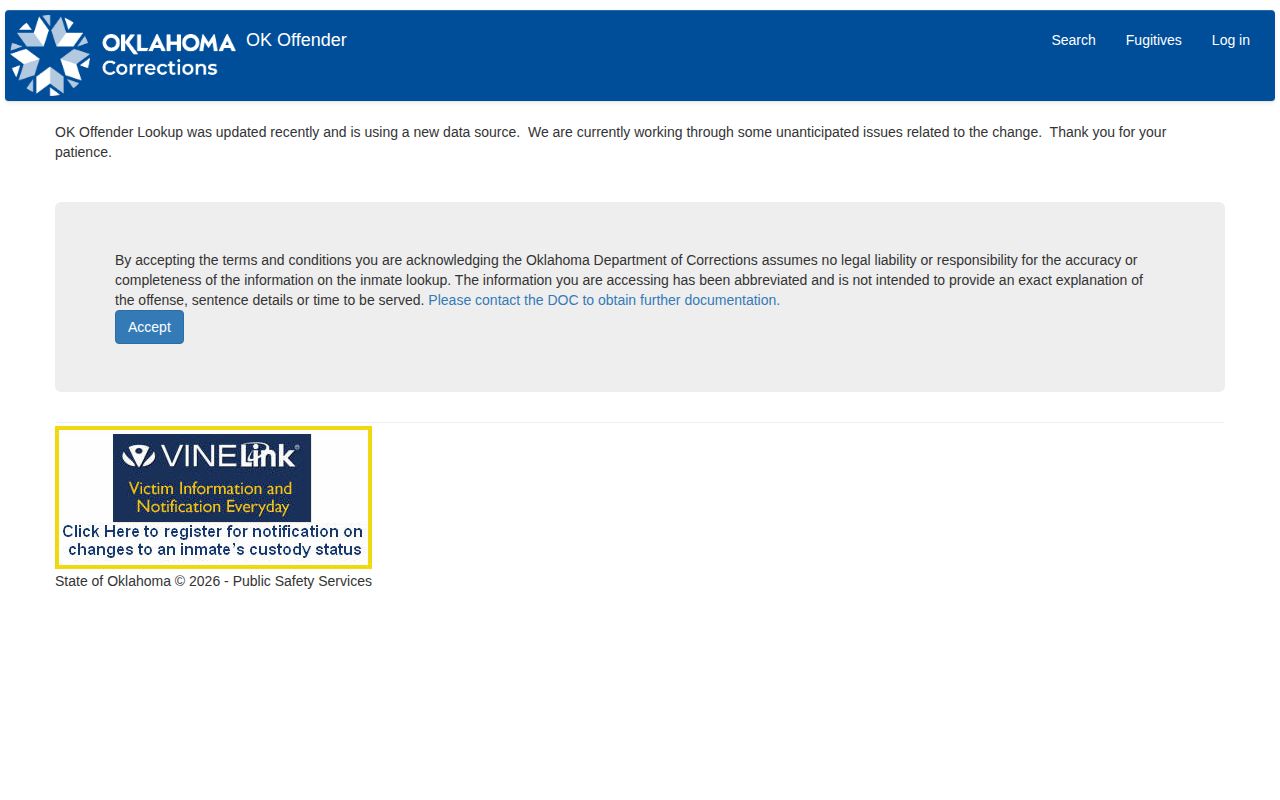
The screen reinforces why ODOC results need identity checks and agency verification before a status is treated as final.
Note: An ODOC prison location means state custody continues even when the Cleveland County jail roster no longer shows the person.
Cleveland County Recent Release Limits
Cleveland County does not publish an official rolling 24-hour or 72-hour released-inmate feed. The CentralSquare county portal is configured for current custody and today. Its public results show a mugshot when supplied, name, date of birth, and arrest date. It does not expose a local released toggle, release timestamp, release reason, or archive. Generic vendor features do not change what Cleveland County has enabled.
The official sheriff mobile app is also not a substitute. Its published feature set covers tips, sex-offender access, staff contacts, news, alerts, closures, and public safety. The store descriptions do not advertise an inmate search, release list, or mugshot archive. A narrow jail-register request is the correct way to seek a date-window list. The Released Last 24 Hours page explains that same-day request and verification chain.
The official current-custody portal is shown below with the local search controls and public result layout.
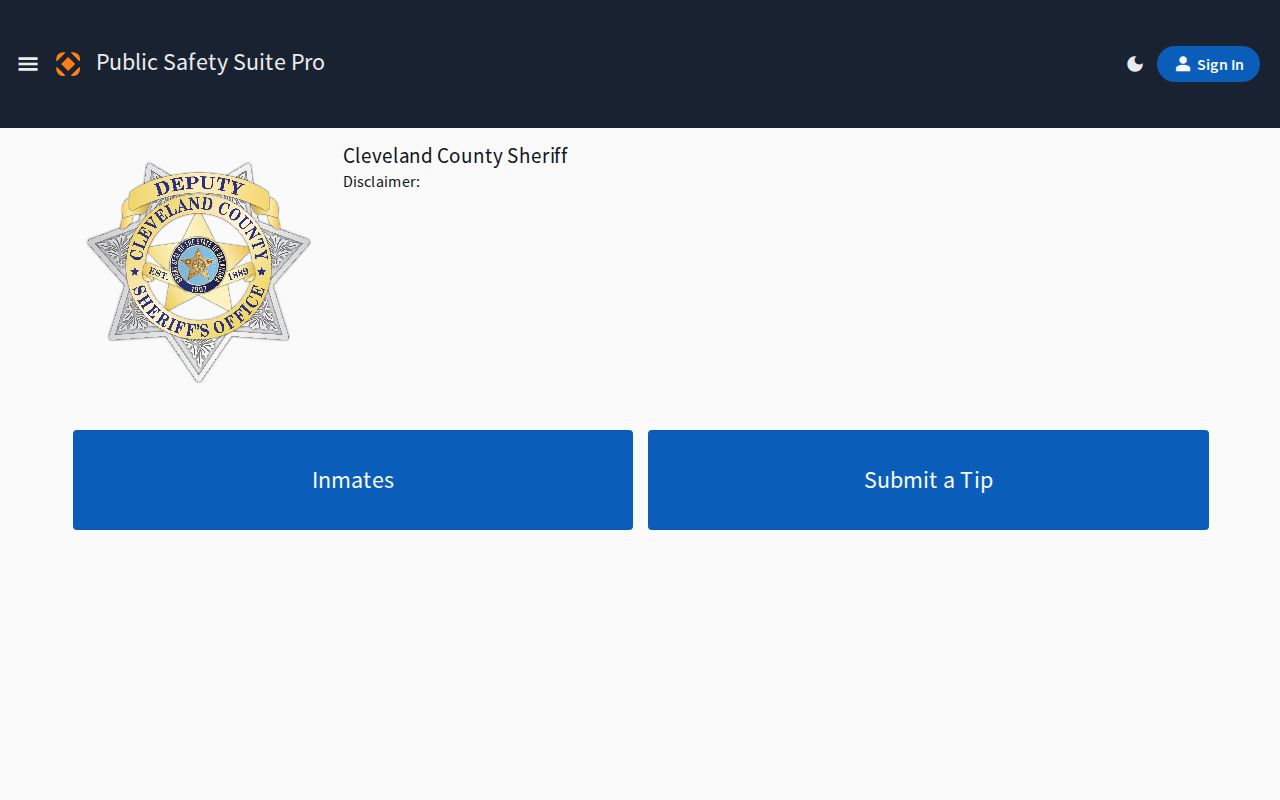
The current-only layout confirms why a released Cleveland County inmate must be traced through records, VINE, courts, or a receiving agency.
Cleveland County Release Supervision
The Oklahoma Pardon and Parole Board makes and records parole decisions. ODOC Probation and Parole Services supervises people in the community. Those roles are distinct from the county jail. The Norman Probation and Parole office at 1919 Industrial Boulevard serves Cleveland County. An exact-name and DOC-number lookup, followed by office confirmation where information is public, is the main route for checking an explicit supervision status.
A parole to detainer or consecutive case means custody continues elsewhere. The Cleveland County Parole / Probation resource separates supervision, discharge, and continued custody outcomes.
Cleveland County Parole Release Timing
A favorable Board vote does not prove release. For a nonviolent parole, the certificate must be signed, a home offer checked, conditions met, and warrants or detainers reviewed. PPB describes a weekly probable-list sequence with a Monday list, Tuesday facility response by 2 p.m., and Wednesday releasing memo. Releases generally occur weekly except the week after Board meetings.
That sequence explains why a docket result and physical prison release can occur on different days. For covered violent cases, gubernatorial action may also follow the Board's recommendation. The final ODOC status, Certificate of Release, VINE custody change, and supervising office establish what happened after the vote.
Cleveland County Release Notifications
OK VINE offers custody checks and notifications by web, app, phone, email, text, or TTY. Search one person, compare identifiers, and write down the reporting facility, exact status, and status date. A released result means that reporting agency ended its custody event. It does not by itself prove dismissal, sentence completion, absence of supervision, or return to the community.
VINE is not a federal locator, and PPB warns that it does not provide parole notification. A transfer from ODOC to a Department of Mental Health facility can also make VINE inactive until the person returns to ODOC custody. For sentenced federal prisoners, the BOP locator can preserve a release date and a "Released" or "Not in BOP custody" result. ICE's locator focuses on current detention, while USMS has no comparable public historical locator. Use those channels only when a Cleveland County record points to federal or immigration custody.
Note: A VINE alert reports a custody change from its source agency, not the full court disposition or every later custodian.
Cleveland County Released Offender Registries
The Oklahoma Sex Offender Registry and the state's violent-offender registration system apply only to people with continuing duties under the governing statutes. They are not lists of every Cleveland County released inmate. A registry result can help identify and locate a covered registrant, but its presence proves the registry record rather than the date a specific jail or prison custody event ended.
Absence has equally narrow meaning. It does not prove that the person remains in jail, that no release occurred, or that an earlier arrest was erased. Registry photographs are identification images maintained for the registration program. They should not be labeled as the Cleveland County booking photograph unless the source and booking match. Use 57 O.S. §§591 through 599.1 for the violent-offender framework and the official registry source for current public fields.
Cleveland County Custody Record Map
Each system answers a limited question. A current roster is not a release archive, and a court order is not the physical gate time. Use the source that owns the custody stage, then compare it with the next system when a transfer is possible.
| System | Best use | Key limit |
|---|---|---|
| CCSO portal | Present Beggs custody | No public released archive |
| CCSO release record | Date and manner county custody ended | May require a records request |
| OSCN or municipal court | Legal order and case disposition | May not show physical exit time |
| ODOC lookup and records | State prison, supervision, or discharge trail | Public data is abbreviated and dates can be limited |
| OK VINE | Reported custody status and alerts | Not a certified release record or parole notice |
| BOP, ICE, or USMS records | Relevant federal or immigration custody | Different coverage and historical limits |
Cleveland County Release Facilities
The county custody map includes one county detention center, two state-prison locations or complexes, municipal holding paths, and federal or immigration systems that may receive a transfer. These links follow the correct release record for each type.
- F. DeWayne Beggs Detention Center: county custody can end in community release, supervision, or transfer.
- Lexington Assessment & Reception Center and Lexington Correctional Center: ODOC intake and prison custody require state records.
- Joseph Harp Correctional Center: discharge, parole, mental-health movement, and institutional transfer must be distinguished.
- Norman Police Department detention/holding function: use the municipal or district court and the actual booking agency.
- Moore Police Department detention/holding function: citation, city release, or transfer to Beggs create different trails.
- Other Cleveland County municipal holding arrangements: verify the arresting city and court rather than assuming county booking.
- Federal Bureau of Prisons system: federal releases stay outside the county roster.
- Immigration custody: release to an ICE detainer can mean transfer, not community freedom.
Cleveland County's local geography makes the county-to-ODOC handoff easy to misread. LARC is the statewide intake point for male ODOC admissions, so a new Lexington location after a Beggs disappearance is strong evidence of continued state custody. Joseph Harp is also an ODOC institution, not a county jail. Always follow the receiving record.
Note: Facility pages use the operator's correct locator, since county, state, federal, and immigration custody records are not interchangeable.
Cleveland County Release Transfer Trap
LARC is Oklahoma's statewide reception point for male ODOC admissions. It assesses, photographs, fingerprints, medically reviews, classifies, and assigns people sent from county jails. A new LARC entry after a Beggs disappearance is thus not a community release. It is a custody handoff that happens within Cleveland County's borders.
A later change from LARC to Joseph Harp or another prison can be another institutional transfer. For those paths, use the DOC number, ODOC status, Certificate of Release, and any VINE or supervision record. The county jail release entry proves only the first transfer.