
Cleveland County Parole Versus Probation
Parole and probation both allow a person to live outside a secure facility under rules, but they arise in different ways. Parole follows a prison term. The Oklahoma Pardon and Parole Board considers parole and records its action, while Oklahoma Department of Corrections Probation and Parole Services handles community supervision. Probation comes from a court sentence. It can follow time in jail, accompany a suspended sentence, or begin without a prison stay. A deferred sentence and community sentencing are also distinct legal programs. The Norman office may route more than one kind of case, so the program name matters.
A person can be released from the F. DeWayne Beggs Detention Center on a suspended sentence and then report for probation. Someone leaving LARC, Lexington Correctional Center, or Joseph Harp may enter parole. Neither outcome is the same as an unconditional discharge. The court judgment identifies probation terms. ODOC records and a Certificate of Release can document a prison-to-supervision change.
| Point | Parole | Probation |
|---|---|---|
| How it begins | Conditional release from an ODOC prison sentence after the required decision and release steps | A court-ordered sentence or sentence component served in the community |
| Decision source | PPB action, with gubernatorial action required in some covered cases | The sentencing court and judgment |
| Supervising agency | ODOC Probation and Parole Services | ODOC or the program named in the court record |
| Best verification | ODOC status, release certificate, and supervising office | Court judgment, ODOC status when applicable, and supervising office |
| How it ends | Formal discharge, expiration, or another official status change | Court or agency completion and discharge under the governing sentence |
Note: The sentence document controls the supervision type; the same Norman address can serve several legally distinct programs.
Check Cleveland County Post-Release Supervision
No separate Cleveland County public parole-and-probation roster was found. The official starting point is OK Offender Lookup. It covers ODOC incarceration and supervision records, not every local jail booking. Its information is abbreviated, and the live system has warned about data-source issues. Match a DOC number and date of birth whenever possible. A shared name alone is weak proof.
Use the following sequence to verify a named person without treating a favorable hearing result as proof of release:
- Search the exact name and DOC number in OK Offender Lookup. Record the status, location, and any explicit parole, probation, or community-supervision wording.
- Read the Cleveland County court case through OSCN when probation, a suspended term, or revocation is possible. The judgment and later docket events identify the legal basis.
- Call Norman Probation and Parole. Ask whether it can confirm that the office holds the case or identify the proper office and program.
- For a parole case, check the matching month at the PPB docket and results index. Treat the Board result as a decision step, not the gate transaction.
- Request a nonexempt supervision or discharge record from ODOC Legal Services when the public status is unclear or historical proof is needed.
Do not assume the office can disclose an officer’s name, check-in time, home address, or supervision plan. Privacy and safety limits may apply. When the person can authorize disclosure, ODOC also provides a route for release of incarceration and supervision records. The broader custody and release path is available through the Cleveland County released-inmate search.
Cleveland County Probation Office Details
ODOC’s directory assigns Cleveland County to Norman Probation and Parole. It also lists a community-sentencing contact at the same location with broader multi-county coverage. That shared address does not make the programs interchangeable. State the court case, DOC number, and the supervision label shown in the record, then ask which unit owns the matter.
Norman Probation and Parole
Oklahoma Department of Corrections
1919 Industrial Boulevard
Norman, OK 73069
Phone: 405-364-2365
Fax: 405-364-3481
The official ODOC Probation and Parole directory is the source for the Norman office listing. The captured directory view below helps distinguish the local supervision office from the Pardon and Parole Board in Oklahoma City.
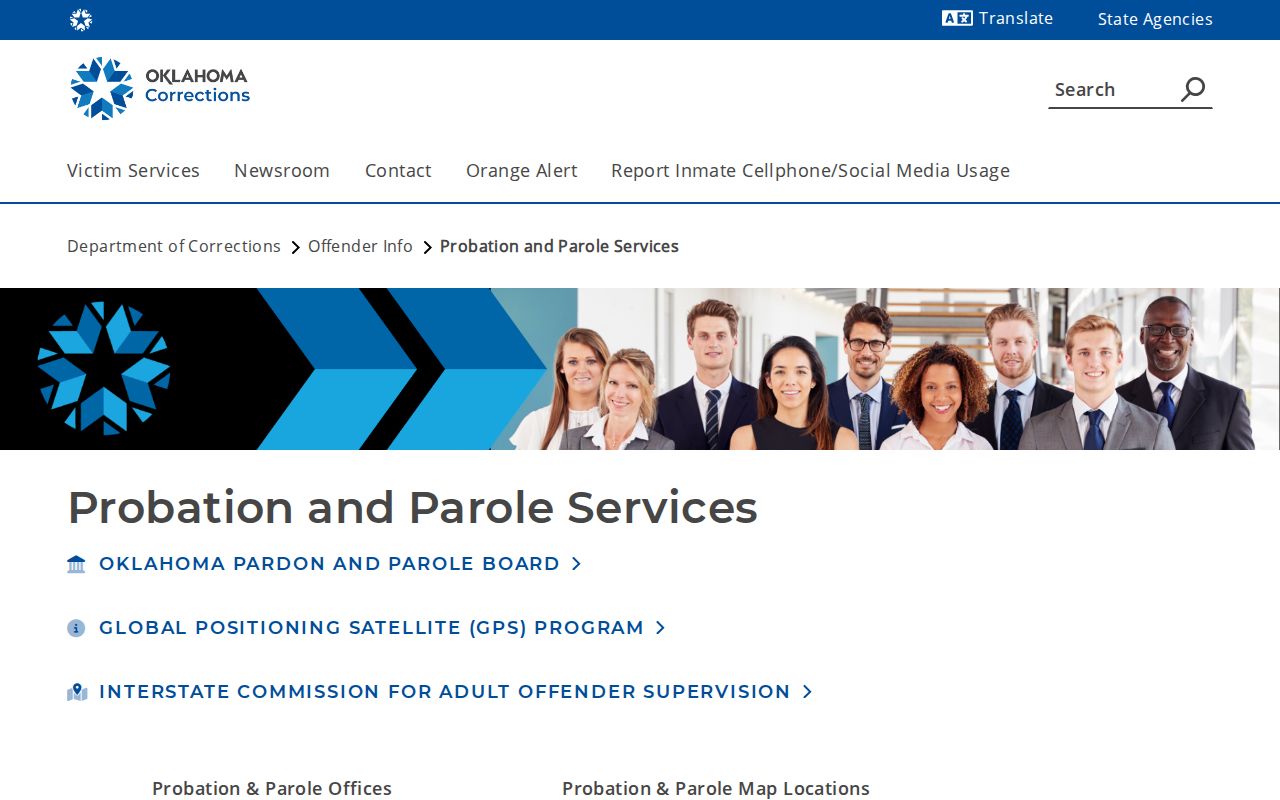
The office listing is a routing source. It does not show whether a specific person has completed supervision, moved to another district, or has an active violation.
Note: Office staff may route an inquiry without disclosing private reporting details, an assigned officer, or a release address.
Cleveland County Parole Board Records
The Oklahoma Pardon and Parole Board meets monthly over several days. Current dates belong on the PPB meeting and calendar page, since times may be set close to a meeting. Its docket-results index publishes monthly dockets and matching result files. A docket may show a name, DOC number, committing county, offense, case number, sentence date and term, PRD, and hearing category. Always compare the exact docket with the matching results legend.
Safe descriptions follow the official result: favorable or granted where the Board has final authority, favorable recommendation to the Governor where that step is required, denied, administrative action, or a displayed status such as stricken, continued, or waived. Votes remain tentative until adjournment. The Board may not provide a reason for denial, and reconsideration timing varies by case class.
Cleveland County Parole Holds
Oklahoma’s parole process has several stages after a favorable nonviolent action. PPB describes a weekly probable list, a facility response, and a final releasing memo. Releases generally occur weekly except during the week after Board meetings. Covered violent cases may also require action by the Governor. The sequence explains why a Board result and a physical release can have different dates.
A detainer is a request or legal hold from another authority. “Paroled to detainer” means ODOC transfers the person to another county, state, country, or immigration authority. “Paroled to a consecutive case” means custody continues under the next sentence. A commutation may reduce a sentence, while a pardon forgives an offense after the relevant process, but neither term alone proves that the person walked out of a facility. Confirm the receiving custodian and the ODOC release record.
Likewise, an absconder is a person alleged to have stopped complying with supervision or stopped reporting. No official Cleveland County-specific absconder list was found. OK Offender Lookup has a Fugitives view, but its scope should not be treated as a complete supervision list. Court and sheriff warrant records answer whether a warrant appears in those systems, not whether supervision has formally ended.
Conditions vary with the judgment, parole certificate, and individual supervision plan. Common records may address reporting, travel, treatment, payments, or other case-specific duties, but no generic list proves one person’s terms. A suspected violation can produce agency review, a court filing, a warrant, or revocation proceedings. None should be inferred from a missed public update. Read the filed order and ask the supervising office which public record can be confirmed.
Cleveland County Parole Eligibility
Parole eligibility depends on offense date, conviction statute, violent or nonviolent classification, exclusions, consecutive terms, and mandatory laws. Under 57 O.S. §332.7, PPB summarizes general nonviolent consideration at one-fourth of the sentence for covered crimes committed on or after November 1, 2018, and one-third for the specified earlier period. These are general thresholds, not a personal release calculation.
Enumerated serious crimes under 21 O.S. §13.1 generally require service of at least 85 percent of the prison term before parole eligibility. The rule is offense-specific. It does not apply to every Oklahoma prisoner. Death and life without parole are ineligible, and other statutes can set their own limits. The controlling judgment, offense date, statutory version, and ODOC sentence audit must be read together.
Parole eligibility means consideration may occur. A favorable or recommended result is a later decision step. Release means the custodian ended physical custody. Discharge means the responsible agency formally ended the custody or supervision status. Keeping those four terms separate prevents the most common Cleveland County parole-record error.
Note: A PRD shown on a Board docket is a scheduling field, not evidence that physical release occurred.
Cleveland County Release Property Pickup
CCSO’s Property Custody unit has a separate appointment process at the detention center. That process may require valid photo identification and legal authority to claim an item. The posted policy also warns that safekeeping property can face disposal after 90 days. This is useful after a jail stay, but it is not the same as personal effects normally handled at the release desk.
The CCSO Property and Evidence page should be checked before a trip because it controls appointment and authorization details. A supervision officer is not the custodian of sheriff-held evidence or safekeeping property. Questions about those items belong with CCSO, while questions about reporting duties belong with ODOC Probation and Parole Services.
Confirm Cleveland County Supervision Discharge
Supervision ends through an official discharge, sentence expiration, court action, or another status change allowed by the governing case. A person’s absence from a public lookup does not establish completion. Records can move to ODOC Closed Records, and a live profile may be abbreviated. For documentary proof, ask ODOC Legal Services for the nonexempt supervision and discharge record, final status, and any relevant status-change document. General Counsel is reached at 405-425-2515, Closed Records at 405-425-2691, and the discharge-only email is osordischarges@doc.ok.gov.
OK VINE is designed for custody information and alerts, not certified supervision discharge. PPB also warns that VINE does not provide parole notification, and VINE can become inactive during an ODOC transfer to a Department of Mental Health facility. Silence from an alert system is not proof that parole ended. Use the office record and a formal discharge source.