
Cleveland County Release Date Labels
Oklahoma records use several dates that answer different questions. The sentence date and term come from a judgment. A parole eligibility date, often shortened to PED, marks when consideration may occur under the governing law. ODOC’s Projected Release Date, or PRD, is a sentence-administration calculation. The actual release or discharge event is the custody change shown by a Certificate of Release, releasing memo, jail register, or other final transaction.
These dates can be far apart. A person can become eligible for parole and be denied. A favorable Board action can be followed by home-offer review, conditions, detainer checks, or a further government decision. A projected date can also change after new credits, misconduct, a corrected judgment, or another case. None of those earlier dates proves that the custodian completed release.
| Date or event | What it means | Best source |
|---|---|---|
| Sentence date and term | The court’s judgment and length or structure of the sentence | OSCN docket, signed judgment, or Cleveland County Court Clerk |
| Parole eligibility date | The point when statutory parole consideration may begin | ODOC sentence record and governing law |
| Projected Release Date | ODOC’s current administrative calculation based on the sentence record and applicable credits | Authorized ODOC information or an official record containing PRD |
| Actual release or discharge | The custodian ended physical custody, possibly into supervision or another custodian | Certificate of Release, releasing memo, or jail register |
Cleveland County Inmate Date Routes
The right route depends on where the person is held and why. The F. DeWayne Beggs Detention Center holds people awaiting court, serving local time, awaiting transport, or held for another authority. A pretrial detainee generally has no sentence-based projected release date. Bond may be posted, a judge may order release, a case may be dismissed, or another hold may keep custody in place. The court gives legal authority, while the jail records the physical release.
LARC/LCC and Joseph Harp are ODOC facilities in Cleveland County. A person who leaves the county jail for LARC has transferred into state custody, not been released to the community. State prisoners follow ODOC sentence and credit rules. Federal or immigration custody follows different systems, so an ODOC calculation should never be applied to BOP, USMS, or ICE custody.
Note: A person can leave the Beggs roster and remain confined at an ODOC institution within Cleveland County.
Find Cleveland County Projected Release Dates
Start with an exact name, date of birth, case number, booking number, or DOC number. One identifier is rarely enough. OK Offender Lookup covers ODOC incarceration and supervision, not every Cleveland County jail booking, and its public information is abbreviated. The system has also warned about data-source changes. Capture the live field wording rather than assuming a PRD is displayed.
- Identify the current custodian. Check the CCSO current roster for county jail custody and OK Offender Lookup for an ODOC prison location.
- Read the judgment. Note each offense date, sentence date, term, suspended or deferred portion, and whether terms are concurrent or consecutive.
- For an ODOC sentence, use the exact name and DOC number. Record any date and status exactly as the live result labels it.
- For a Cleveland County jail sentence, obtain the judgment, jail-credit order, and CCSO’s calculation or date-and-manner-of-discharge record.
- Check PPB records only when parole is relevant. A PRD column or favorable action is not proof of release.
- Confirm the final event through the Certificate of Release, jail register, or receiving agency when a transfer or detainer appears.
The Cleveland County released-inmate lookup connects the current roster, court, VINE, ODOC, and records-request paths for a named person. When the need is a date calculation, keep the judgment and the custodian’s administrative record at the center.
Oklahoma PRD Is Tentative
ODOC uses “Projected Release Date” in its Section 06 forms index, including OP-060203 Attachment A. The same index names the Monthly Offender Evaluation Time Credit Report, Certificate of Release, Notice of Inmate Status Change, and Consolidated Record Card. Those titles show that the projection and the final release record are separate artifacts.
Yet ODOC’s public offender FAQ says the exact inmate release date is confidential to ordinary inquirers without a legitimate need. It also calls the date tentative because credits and disciplinary events can change it. A PPB docket may contain a PRD column, but that is a Board scheduling record. It does not prove that OK Offender Lookup displays the same field or that release took place.
The ODOC Section 06 forms page shows the state’s named projected-date and release documents. The captured source below is useful for asking for the correct record instead of demanding an informal estimate.
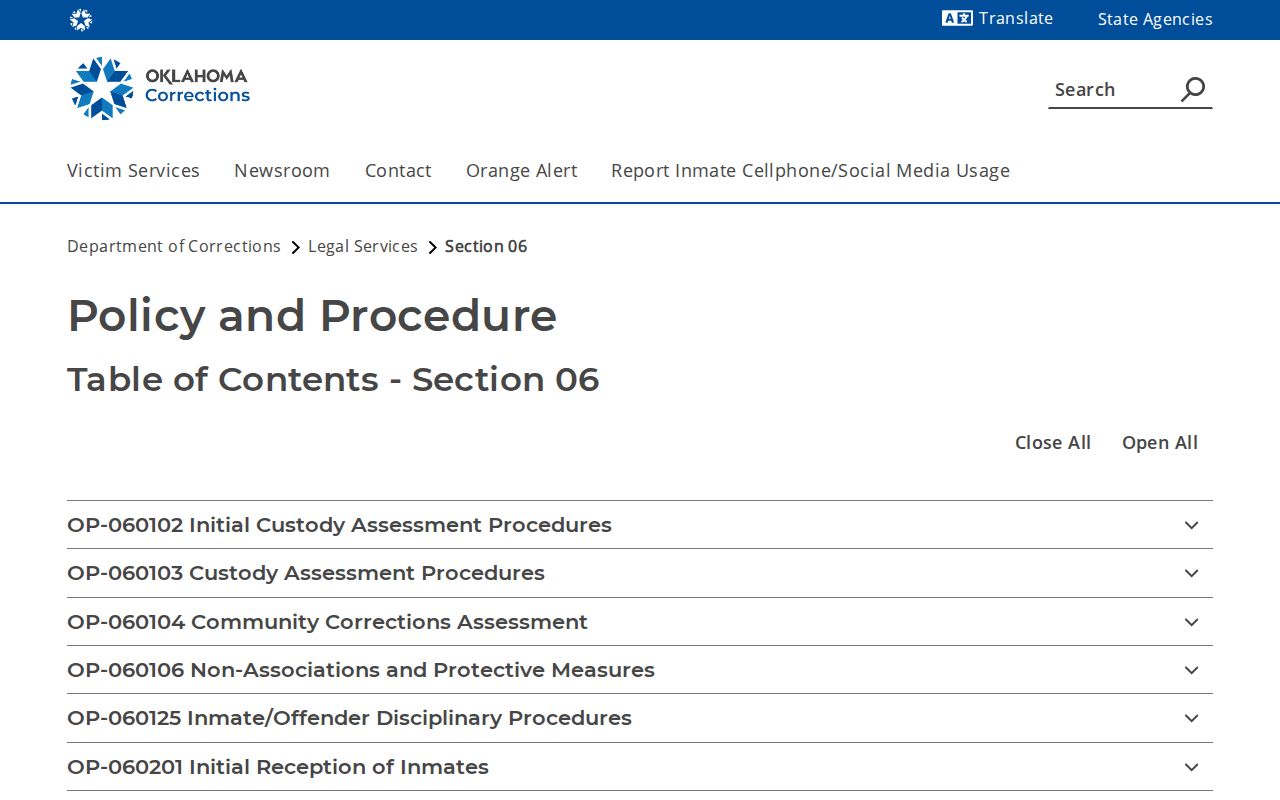
The form names do not mean that every record is public in full. They provide precise terminology for an authorized inquiry or a request for nonexempt material.
Note: Capture the exact live field label because ODOC does not promise that every public profile displays a PRD.
Cleveland County Sentence Date Computation
A sound baseline begins with every judgment. Determine the offense date, sentence date, prison portion, suspended or deferred portion, and any credit for time already spent in jail. Then identify concurrent and consecutive terms. Concurrent terms run at the same time, while consecutive terms run one after another. A new consecutive case can keep a person in custody after an older calculation appears to end.
Next, determine which statutory minimums, exclusions, and earned-credit rules apply. The law may depend on the offense and the date it occurred. Administrative staff must also account for earned-credit class, achievement credits, forfeitures, restorations, and sentence corrections. Parole eligibility is calculated separately. Multiplying the imposed term by one percentage is not enough.
A Cleveland County jail sentence needs its own record path. ODOC’s public class-level schedule does not control a local jail calculation unless the person is legally serving an ODOC sentence through an applicable arrangement. Ask CCSO or the court for the actual calculation, jail-credit order, and release transaction. Do not transplant prison-credit assumptions to a local jail term.
Cleveland County Earned-Time Rules
For eligible ODOC sentences, 57 O.S. §138 establishes the earned-credit framework. The usual monthly schedule lists zero credits at Level 1, 22 at Level 2, 33 at Level 3, and 44 at Level 4. Statutory criteria still control. Work, program status, conduct, and other requirements can affect the assigned level, and achievement credits may be available for specified accomplishments.
Credits are not guaranteed future days. Misconduct or nonperformance can cause loss, while restoration is discretionary and follows ODOC procedure. The statute applicable to the offense and sentence determines whether credits are available and how they work. ODOC’s sentence-and-credit guide should be read with the actual judgment and record.
Under 21 O.S. §13.1, a person convicted of an enumerated serious offense must serve at least 85 percent of the term of imprisonment before parole eligibility. Credits cannot reduce confinement below that statutory floor. This is not a rule that all Oklahoma prisoners serve 85 percent. Other offenses can have separate limits, so the conviction statute and offense date are essential.
The Oklahoma Title 57 statute source supplies the governing credit and parole framework. Check the codified law applicable to the offense date rather than treating an old summary as the final rule.
Cleveland County Parole Date Differences
Under 57 O.S. §332.7, covered nonviolent crimes committed on or after November 1, 2018 generally reach parole consideration at one-fourth of the sentence. The relevant earlier post-1998 period generally uses one-third. Mandatory provisions, violent classifications, exclusions, prior transactions, and consecutive terms can change the route. Life without parole is ineligible.
PED is eligibility for consideration. PRD is sentence administration. A favorable or recommended Board result is a decision step. Release is the physical custody endpoint. Even after favorable nonviolent action, Oklahoma’s process can require a signed certificate, verified home offer, completed stipulations, and checks for warrants or detainers. For covered violent cases, gubernatorial action may also follow.
A parole to detainer transfers the person to another authority. A parole to a consecutive case continues incarceration on the next sentence. Both can coincide with an ODOC release transaction but neither means the person returned to the community. The receiving system must be checked.
Note: Parole eligibility, a favorable result, a projected date, and physical release are four distinct events.
Why Cleveland County Release Dates Move
Projected dates change when the facts or rules behind the calculation change. Some changes move the administrative date. Others leave the displayed PRD in place but prevent a community release. The source record should identify which kind of event occurred.
| Factor | Possible effect | Verification source |
|---|---|---|
| Earned-credit level | A higher or lower eligible class changes the pace of credit earning | ODOC credit report and sentence audit |
| Achievement credit | A qualifying award may reduce the remaining calculation | ODOC consolidated record |
| Misconduct or nonperformance | Credits may be forfeited and a tentative date may move later | ODOC disciplinary and credit record |
| Jail-time correction | Corrected credit for prior custody can change the baseline | Court order and ODOC audit |
| Appeal or post-conviction order | A changed judgment can alter the term or structure | Signed court order |
| Consecutive case or revoked term | Custody may continue beyond the earlier sentence date | Judgments, revocation record, and custodian status |
| Detainer or another hold | The first custodian may release the person to a new custodian | Release transaction and receiving-agency record |
PPB also identifies file-audit corrections, commutation, misconduct near hearing, and waiver as reasons a hearing or schedule can change. A court can enter a corrected judgment. A new case can add a hold. Always return to the current record before relying on an older calculation.
Confirm Cleveland County Actual Release
For a county jail case, request the jail register and booking-to-release transaction through CCSO Records. Oklahoma law identifies date or manner of discharge as public jail-register information if kept. Include full name, date of birth when known, booking or case number, and an approximate range. Ask whether the person left for the community, ODOC, another jail, federal custody, or immigration custody.
For an ODOC sentence, request the Certificate of Release, discharge date and type, status-change notice, and nonexempt consolidated-record material through ODOC Legal Services or Closed Records. A certificate can distinguish discharge from a move into parole or another status. If a VINE alert is useful while release is pending, the Cleveland County VINELink release check explains custody notifications, but VINE is not a certified discharge record.
Use exact terms in the final conclusion. “Projected” means calculated. “Eligible” means consideration can occur. “Granted” or “recommended” describes a decision. “Released” means the reporting custodian ended physical custody. Then state whether the destination was community supervision or another custodian.