
Cleveland County Three-Day Release Records
No official 72-hour or 48-hour released-person list was found for Cleveland County. The Sheriff's inmate-search page leads to a public portal set for people in custody today. It does not offer a released filter, a release timestamp, a rolling date window, or a historical archive. There is no separate feed URL, published update cycle, or online retention period to report.
A three-day list must therefore come from records rather than a public dashboard. Ask CCSO for an existing release log or jail-register entries bounded by exact start and end dates. This gives the agency a clear scope and avoids treating the current roster as something it is not. The request may return date or manner of discharge and related nonexempt fields if those items are kept.
Check Cleveland County 72-Hour Releases
Begin with a firm time span. “The last three days” can shift while a request is processed, so state calendar dates and times instead. If the goal is one person rather than a complete list, include identifying facts and use the named-person verification chain. The Cleveland County same-day release check narrows that process when the likely event occurred today.
- Define the precise 72-hour interval, including the beginning and ending date and time.
- Check the CCSO current roster only to see who is displayed in custody now.
- Request the existing jail register or release log from CCSO Records for the defined interval and ask for electronic delivery.
- For a named person, search OK VINE and preserve the reporting agency, custody status, and event date.
- Review OSCN for the Cleveland County case and any release, bond, sentence, dismissal, warrant, or detainer entry.
- Search OK Offender Lookup if a state-prison transfer or state sentence is possible.
- Confirm the physical custody change with the jail or the receiving agency before describing it as community release.
The result from any one channel has limits. VINE reports a custody event for its source agency. A court docket records legal acts. ODOC covers state incarceration and supervision, not every county booking. The CCSO register ties the local admission to the local discharge transaction.
Note: A narrowly framed interval is easier to identify than an open-ended request for all recent Cleveland County releases.
Cleveland County 72-Hour List Fields
Because the county publishes no web feed, there are no official online 72-hour columns. The table distinguishes the current-roster fields a reader can see from the release fields that should be requested. This boundary prevents a current arrest date from being mistaken for a discharge date.
| Field | Source and meaning |
|---|---|
| Mugshot | Current roster only, where a photo is supplied. |
| Name and date of birth | Current roster identifiers used to reduce same-name errors. |
| Arrest date | Current roster booking context, not a release field. |
| Booking number | A requested identifier for the exact county custody event. |
| Admission date and time | When the jail booking began, if kept and public. |
| Release date and time | The recorded end of CCSO physical custody. |
| Date or manner of discharge | Jail-register information identified by 51 O.S. §24A.8 when kept. |
| Receiving agency or detainer | Evidence that the event may have been a transfer rather than freedom. |
The official Cleveland County portal illustrates the present-custody limitation and its narrow public field set.
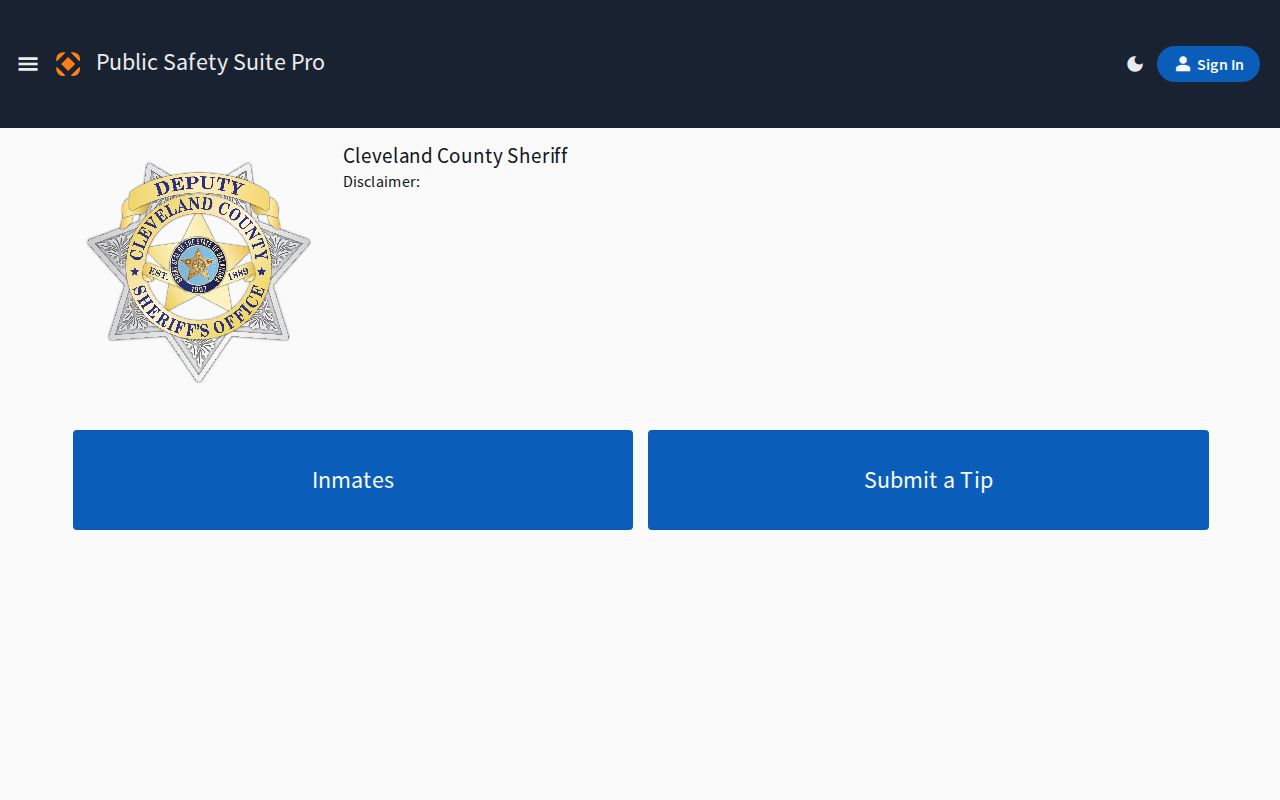
The portal is useful as a current snapshot, while the three-day release record must be requested from CCSO.
Cleveland County Weekend Release Checks
A 72-hour span is practical around weekends because it covers more than one court and office day. Yet Cleveland County publishes no special weekend or holiday release feed. CCSO also gives no public schedule of fixed release hours. A reader should not assume that a release order entered before a weekend created an immediate exit or that a Monday roster change occurred on Monday.
CCSO states that normal processing takes one to three hours after the jail receives release paperwork, absent extenuating circumstances. This estimate explains a gap between a court action and physical departure. It does not establish a guaranteed time. Holds, other cases, agency transfers, and the arrival of paperwork can affect what happens next. The signed order and jail transaction may therefore show two valid but different times.
When the interval crosses a holiday, specify all dates in the records request and ask whether an existing log uses booking, discharge, or posting time. The CCSO Records Office lists weekday business hours and closes on stated holidays. The detention center, however, controls custody and should be called for public status questions. A records-office schedule is not a jail-release schedule.
Note: Use the jail transaction for physical exit time, because a court docket may show authority without the gate event.
Request Cleveland County Release Logs
Section 24A.8 of the Oklahoma Open Records Act identifies jail-register or booking information that includes the date or manner of discharge when kept. A request should name the existing jail register, jail blotter, booking record, or release log. It should not demand analysis, a custom narrative, or a new report.
For a three-day list, ask for the prisoner's name, booking number, admission date, date or manner of discharge, and receiving agency when maintained and nonexempt. Seek electronic copies and a cost estimate. Section 24A.5 allows reasonable direct-copy fees and permits search fees only under statutory conditions. The published $5 report-copy amount from CCSO Records is not a guaranteed total for a multi-day log.
Cleveland County Release Records
CCSO Records Office
2600 W. Franklin Road
Norman, OK 73069-8012
405-701-8888
ccsorecords@clevelandcountyok.com
Monday through Friday, 8 a.m. to 5 p.m.
The detention center can be reached at 405-701-7700 for a public status question. Records staff provide the documentary route. If part of a record is exempt, ask for the segregable public part and the legal basis for any withheld portion.
Cleveland County Roster Data Quirks
Cleveland County's local CentralSquare settings explain the absence of a three-day archive. The search initialization exposes name and in-custody filters, with current custody tied to today. Although the wider software platform may support release controls elsewhere, this sheriff configuration does not. County-enabled fields, not generic vendor capability, define what is publicly available here.
Once a person no longer qualifies for the current display, no official online retention period applies because no released archive is offered. A no-result can be caused by release, transfer, a name mismatch, lag, or a booking at another facility. The portal also does not state a refresh rate, so “current” is accurate while “real time” is unsupported.
That data gap is not evidence that the release record does not exist. The CCSO Records Office processes detention records, and Oklahoma law specifically names jail-register discharge data when kept. Older or date-bounded questions belong with the record custodian, not a screen built only for people now in jail.
- Current roster
- A view of people displayed in custody now.
- Release log
- An existing agency record of people whose county custody ended.
- Retention
- The period records remain available; CCSO publishes no online release-archive period.
- Transfer
- The end of one agency's custody followed by another agency's intake.
Verify Cleveland County Custody Outcomes
A complete 72-hour list answers who left CCSO custody, but it may not answer where each person went. Release on bond returns a person to the community while the case remains pending. Time served or sentence completion may end the local confinement. A transfer to LARC, Joseph Harp, another jail, the U.S. Marshals Service, or immigration authorities continues custody elsewhere.
Use VINE to see the reporting agency and exact custody-status wording. Then match that event to the court case and CCSO release record. If ODOC is involved, a listed prison location means state custody continued. Parole or probation language can indicate release from physical prison custody with supervision still active. An ODOC public record is abbreviated, so official records may be needed for discharge confirmation.
Federal and immigration paths have separate tools. The BOP locator can preserve a released status for covered federal prison records. The ICE locator is mainly for current detention and is not a full historical archive. USMS has no comparable public release locator. These routes should be used only when the county record or court case points to that custodian.
Cleveland County Named-Person Follow-Up
For one person, start with full name, date of birth, approximate booking date, and any booking or case number. Save all identifiers from the current portal before they vanish. A VINE match should be checked against more than the name. Record the status date and reporting facility exactly as shown.
Next, read the court chronology. A bond order, dismissal, sentence, credit for time served, revocation, warrant, or detainer may explain the legal path. Multiple cases can create separate holds. A dismissal in one case does not prove release when another case remains active. For precise proof, request the CCSO booking-to-release transaction and ask whether the discharge was to the community or a named receiving agency.
This sequence is more reliable than waiting for a nonexistent rolling feed. It also preserves the main value of the wider window: a three-day range can catch the event even when the exact day was not known at the start.