
OK VINE in Cleveland County
OK VINE is Oklahoma's free and confidential custody-information and notification service. The Oklahoma Attorney General's OK VINE page describes access by web, mobile app, and toll-free telephone. Service is available around the clock, and notification choices can include in-app messages, phone, email, SMS, and TTY.
Official state material describes a network that incorporates county detention-center and Oklahoma Department of Corrections information. CCSO also points to VINE in its victim-rights resources. No reviewed official participation list named Cleveland County line by line, so a missing Beggs Detention Center record should lead to a call to VINE and CCSO, not an assumption that release occurred.
Use VINELink with Oklahoma selected or call 1-877-654-8463. The service follows reported custody records. It does not replace the jail register, court order, ODOC Certificate of Release, or another custodian's intake record.
Search Cleveland County VINELink Records
A careful search begins with the state and the person, not a broad list of recent names. Exact spelling and an offender identifier help. If several results share a name, compare every displayed identifier before opening or registering on a record. Do not use age or name alone when more detail is available.
- Open VINELink and select Oklahoma as the state.
- Choose the custody or offender search offered by the live interface.
- Enter the exact first and last name. Add the offender ID when known.
- Review all matches and compare identifying details rather than assuming the first name match is correct.
- Open the matching record and write down the reporting agency, facility, exact custody status, and event date.
- If Cleveland County information is absent or unclear, call the VINE hotline and the F. DeWayne Beggs Detention Center at 405-701-7700.
A no-result has several possible meanings. The spelling may differ, the booking may belong to another agency, the data may lag, or the record may not be in the network. A no-result does not prove the person is released. For a complete named-person path across jail, court, and receiving systems, use the Cleveland County released inmate search.
Note: Match the reporting facility and identifier before registering, because a shared name can lead to alerts about the wrong person.
Cleveland County VINE Release Fields
VINELink fields vary by reporting agency and record. Record the live labels rather than forcing them into a county-jail form. A “released” status is evidence that the reporting custodian ended its event, but it does not tell the full legal story or guarantee that the person entered the community.
| Field | How to read it |
|---|---|
| Name and identifier | Use both to confirm the record belongs to the intended person. |
| Reporting agency | The jail, prison system, or other participating source that supplied the event. |
| Facility | The reported place of custody or agency location, when shown. |
| Custody status | The source's exact wording for the person's status. |
| Status or event date | When the reported custody change was recorded, not a full case disposition. |
| Notification choices | The delivery methods offered for that record and event type. |
The official Oklahoma VINELink application is the source for the live search fields and registration flow.
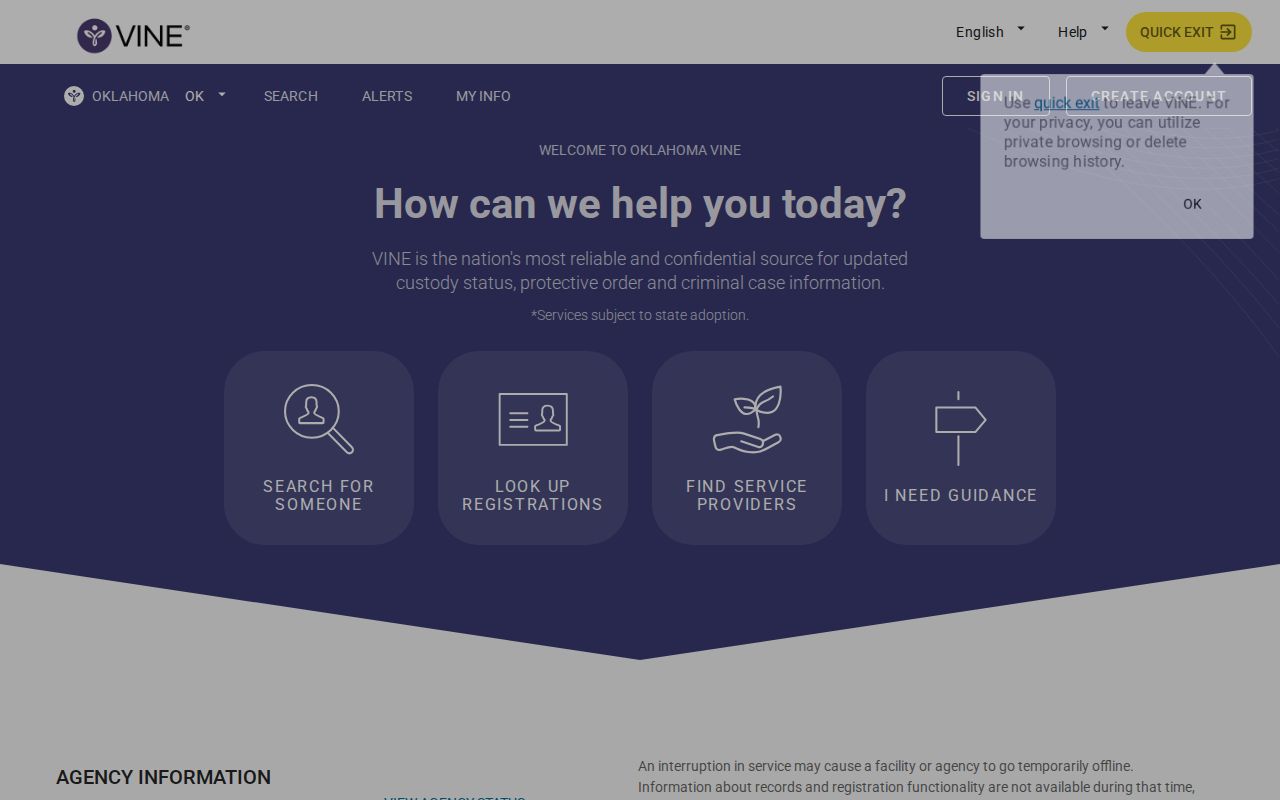
The displayed interface should control what a reader enters and records, because fields and agency filters can change over time.
Read Cleveland County Released Status
When VINELink reports “released” or another custody change, begin with the reporting custodian. A CCSO event means Cleveland County custody ended. It does not prove dismissal, sentence satisfaction, lack of supervision, or freedom from all other holds. A jail may release a person on bond, after time served, to ODOC, to another county, or to a federal or immigration authority.
A state-prison event has its own meaning. Release from physical ODOC custody can lead to parole or another form of community supervision. A transfer between LARC, Joseph Harp, and another ODOC facility is continued state custody. A move to a Department of Mental Health facility creates a special VINE gap described by the Pardon and Parole Board.
| VINE event context | Next verification source |
|---|---|
| Beggs Detention Center release | CCSO jail register and the Cleveland County court case |
| Transfer to ODOC | OK Offender Lookup and ODOC records |
| ODOC release or discharge | Certificate of Release and supervision status |
| Transfer to another jail | The receiving county or facility |
| Federal or immigration handoff | BOP, federal court, USMS records, or ICE as appropriate |
The court docket can explain bond, dismissal, sentence, time-served credit, warrants, and detainers. The jail or ODOC record confirms the physical custody transaction. Reading both prevents a court event from being mistaken for the exact release moment.
Register Cleveland County Release Alerts
Registration begins from the correct individual record. Choose only the channels offered by the live service, and use contact details that can be kept current. Oklahoma material lists app, phone, email, text, and TTY options, but a particular record or event may present a smaller set.
- Open the verified individual record and select the registration or notification action.
- Choose one or more available delivery methods.
- Enter the requested phone number, email address, app information, or TTY details.
- Complete the confirmation shown on screen for each chosen channel.
- For automated calls, create or enter the requested PIN and retain it for acknowledging messages.
- Update or manage the registration if a phone number, email address, or notification need changes.
The official materials reviewed did not state a PIN length. Do not guess one. Follow the live prompt or call 1-877-654-8463 for exact instructions and language help. OAG program information is also available at 405-521-3921.
An alert should trigger verification, not end it. Write down the message, date, and reporting agency. Then contact that agency or check its official record to learn whether the event was release to the community, a transfer, or another status change.
Note: Keep registration details current, since a valid alert cannot reach a phone number or email address that no longer works.
Oklahoma Custody and Parole Alerts
Oklahoma has a distinctive split between custody notification and parole notification. VINE handles custody changes, while the Oklahoma Pardon and Parole Board states that VINE does not provide parole notification. People who need notices about Board proceedings or parole action must also use the PPB's separate victim-notification process.
This distinction matters for a Cleveland County state prisoner. A favorable Board vote is not physical release. Home-offer verification, conditions, warrants or detainers, certificate execution, and the releasing sequence may still stand between the Board action and departure from prison. For covered violent cases, action by the Governor may also follow a favorable recommendation.
The PPB VINE limitations page also documents an interruption when a person transfers from ODOC to a Department of Mental Health facility. VINE can become inactive until the person returns to ODOC custody. Silence during that interval must not be treated as proof that nothing changed.
Cleveland County VINELink Limits
VINE is not a certified discharge record. Participating-source data can lag, and the system may not reveal each release condition, destination, court disposition, or new custodian. A lack of alerts does not prove that custody remained unchanged. The registration may be wrong, contact details may be stale, the source data may be delayed, or the event may fall outside VINE coverage.
Federal custody is outside VINELink. A sentenced federal prisoner should be searched in the BOP Inmate Locator, which can preserve a release date and released status for covered records. Federal pretrial custody often involves the U.S. Marshals Service and a federal court order; USMS has no public historical locator comparable to BOP. ICE's locator is aimed mainly at current immigration detention and is not a complete after-release archive.
County and state systems also differ. The CCSO current inmate portal is limited to present county custody. OK Offender Lookup covers ODOC incarceration and supervision, not every Cleveland County jail booking. A person may disappear from the county roster and appear at LARC because of a state transfer. That is not community release.
Confirm Cleveland County Release Events
For a Beggs Detention Center event, call 405-701-7700 and request the booking-to-release record through the CCSO public-records channel when written proof is needed. The current roster can show that a person is displayed in custody now, but disappearance alone cannot supply a release date or manner of discharge. The jail register is the better local record.
For a Cleveland County court case, OSCN can show bond orders, dismissals, judgments, time-served credits, warrants, and detainers. Those entries establish legal events. The jail record establishes the physical custody change. When ODOC is involved, check the public lookup, then request the Certificate of Release, discharge date or type, and relevant status-change record from ODOC Legal Services or Closed Records.
Use the custody sequence that the facts support: arrest, booking, custody, release or transfer, possible supervision, and final discharge. VINE is strongest in the middle of that chain, where prompt custody notification helps a person notice a change and identify the reporting agency. Official records then establish what the change meant. Preserve the alert wording and event date so the jail or state records office can locate the same custody transaction.
- Custody status
- The reporting agency's description of where the person stands.
- Release
- The end of custody by that specific reporting agency.
- Parole
- Release from physical prison custody under supervision and conditions.
- Discharge
- The recorded end of a custody or supervision obligation.
- Detainer
- A hold that may send the person to another custodian.