
Federal Releases Affecting Cleveland County
The Federal Bureau of Prisons holds people serving federal prison sentences. That system is separate from the F. DeWayne Beggs Detention Center and the Oklahoma Department of Corrections. A person can start with a Cleveland County arrest and later enter federal custody, but the county portal does not track the federal sentence. Likewise, the absence of a name from the CCSO portal gives no proof that BOP ever held the person.
A BOP release can mean the person is no longer in BOP custody. It does not prove that all legal controls ended. Federal supervised release may follow imprisonment. Another warrant, state sentence, immigration hold, or other agency can also take custody. The result must be read as the end of BOP custody only. When a transfer follows, the receiving record is the next link in the chain.
"Released" or "Not in BOP custody" ends the BOP custody event. It does not rule out supervision or custody by another authority.
Confirm Cleveland County Federal Releases
The BOP Inmate Locator is the main public search for covered federal prison records, principally from 1982 forward. A register number is the most direct identifier. A name search can also use age, race, and sex filters. Compare the full result instead of accepting the first same-name record. BOP results can show the person's name, register number, age, race, sex, release date, and location.
- Search by register number if it is known. Otherwise enter the full name and narrow the result with the offered identifiers.
- Match the register number and biographical fields before relying on the record.
- Read the location and release wording exactly. A past release date without a facility may document the end of BOP custody.
- Check the federal court docket for the judgment, release order, sentence, or conditions.
- If another custodian is named, continue with that agency rather than treating the BOP result as community freedom.
First Step Act calculations and other sentence administration can change projected dates. A projected date is not the same as an actual released result. For one Cleveland County person, the sound record set may include the federal judgment, BOP locator entry, release computation or agency record, and any later supervision or transfer document.
The official BOP locator search and result format are shown below. BOP also explains the meaning and coverage of locator data on its inmate-record information page.
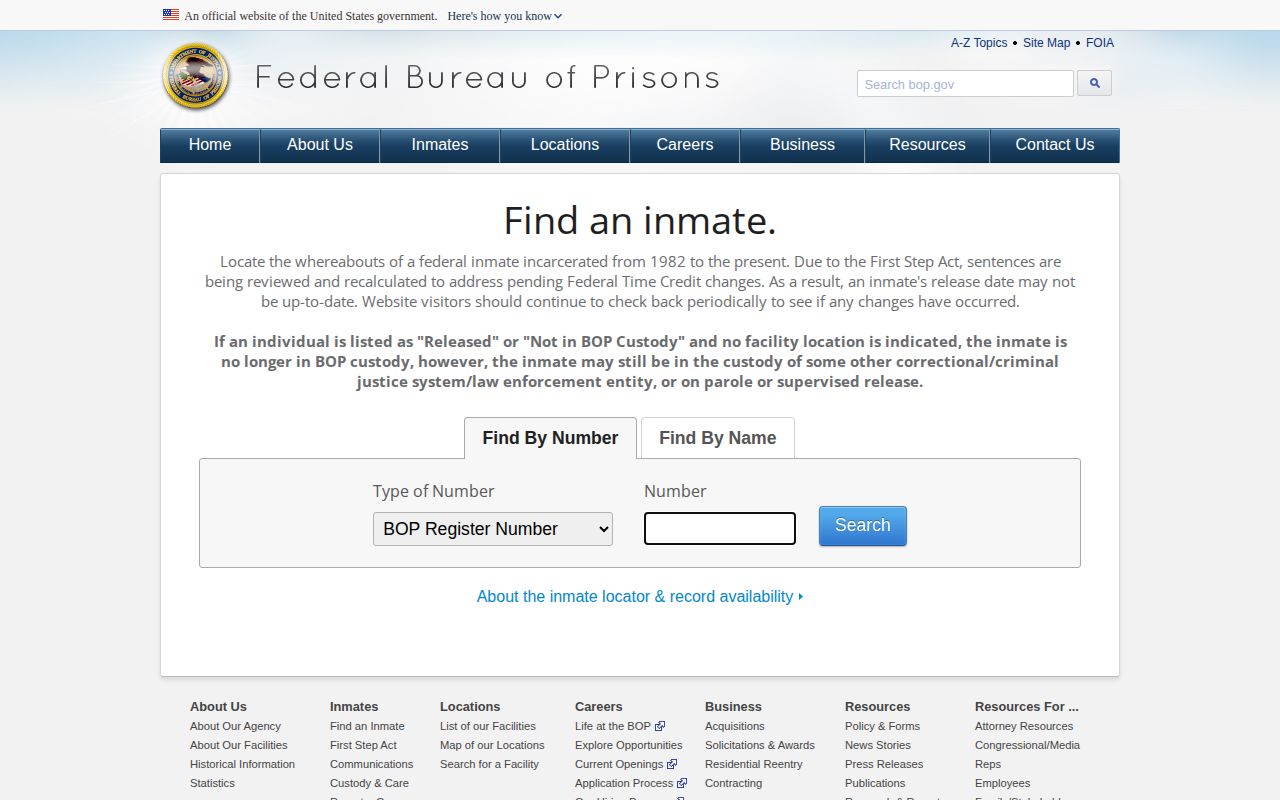
The official fields help separate a sentenced federal record from a county booking or an immigration custody event.
USMS Release Records in Cleveland County
The U.S. Marshals Service manages federal prisoners in transit and many people held before federal trial. It does not provide a public historical locator comparable to BOP. A federal defendant can be placed in a local contract jail, released under a federal court order, and never appear as a sentenced BOP prisoner. A failed BOP search is therefore not proof that no federal detention occurred.
For a pretrial case, start with the federal court docket and identify the detention or release order. The docket supplies legal authority and conditions, while the actual holding facility supplies the physical release transaction. When the location is unclear, an appropriate USMS Freedom of Information Act request can seek agency records. Ask for an existing record tied to the person's identifiers, case number, district, and a narrow date range.
| Federal source | What it can show | Main limit |
|---|---|---|
| BOP locator | Covered sentenced-prison record and release date | Not every federal detention enters BOP |
| Federal docket | Detention, release authority, sentence, and conditions | May not state the physical gate time |
| Holding facility | Admission and physical release transaction | Must first identify the correct jail |
| USMS records | Transit or pretrial custody records when releasable | No public name locator |
Cleveland County Federal Custody Handoffs
The county release record should name the destination agency when that information is maintained and public. A notation such as release to USMS signals a handoff, not an ordinary walk-out release. Search the federal docket next. If BOP later receives the person after sentence, the BOP register number becomes the key identifier. When no BOP admission occurs, the court, USMS, and contract facility remain the relevant sources.
Ask CCSO for the date and manner of discharge under the Oklahoma jail-register rules when a federal handoff began at Beggs. That local document proves when county custody ended. It cannot by itself prove when federal custody ended. The distinction is central in Cleveland County because one physical departure can close the sheriff's event and open a different government custody event at the same time.
The full county-jail search and records path appears on the Cleveland County released inmates home page. Use it only for the county portion of the custody history, then return to the federal sources for the later event.
Note: A CCSO release-to-USMS record and a later BOP result can both be accurate because they document separate federal custody stages.
Cleveland County Release Transfer Trap
Cleveland County contains the county jail in Norman and two major ODOC sites in Lexington, but no identified BOP institution. A person who leaves Beggs and appears at the Lexington Assessment and Reception Center has entered Oklahoma state custody, not federal prison and not the community. LARC is the statewide reception point for male ODOC admissions. Joseph Harp is also an ODOC prison.
This local fact must be resolved before starting a BOP search. Use the receiving agency named in the CCSO release record. An ODOC location calls for OK Offender Lookup and state records. A USMS handoff or federal judgment supports the federal branch. County geography does not change the operator or the record system.
Older Cleveland County Federal Records
BOP describes its locator coverage as principally 1982 forward. Earlier federal prison records may require the National Archives and Records Administration. Historical research works best with a full name, date of birth, register number if known, sentencing court, case number, institution, and an estimated time range. Those details guard against mixing records from people with the same name.
Records can also differ because one source documents a court event and another documents custody. A sentence modification does not itself prove the date the custodian carried it out. A federal supervised-release term begins a community-control phase but is not continued prison confinement. Define the event before deciding which document is missing.
- Register number
- The federal identifier used to distinguish BOP records.
- Supervised release
- A court-ordered period of federal supervision after prison custody.
- Pretrial detention
- Custody before final judgment, often managed through USMS and a holding facility.
- Release order
- The court's legal authority, which is distinct from the facility's physical processing record.
Note: NARA may hold an older federal prison record that falls outside the BOP locator's principal coverage period.
Cleveland County Federal Release Dates
A BOP result can contain a release date, but its meaning depends on whether the date is past, projected, or attached to a current location. For a completed event, BOP explains that "RELEASED" means the person is no longer in BOP custody. A past date with no institution can document when BOP custody ended. A future date remains subject to sentence administration and should not be presented as a fixed exit promise.
The federal judgment supplies the sentence imposed by the court. BOP administers that term and may account for credits and other governing rules, including changes tied to First Step Act calculations. A court can later modify a judgment. Each source can therefore show a different date for a valid reason. The actual release entry answers when BOP ended custody, while the judgment and later orders explain the legal framework.
Federal supervised release is another distinct stage. It is imposed by the court and follows prison in many cases. A person marked released by BOP may still have federal reporting duties and conditions. Those conditions belong in the court record or supervising agency's records, not in the Cleveland County jail portal. A federal parole record can also require different historical research, since federal sentencing systems and dates vary.
When a BOP result is absent, test the premise before assuming that data vanished. A federal pretrial defendant held for USMS may never have become a sentenced BOP prisoner. A person may also fall outside the locator's main time coverage or appear under a different identity spelling. Search the docket, identify the custodian, and request the record created at that stage. This sequence preserves the difference among detention, sentence, projected release, actual release, and later supervision.
Cleveland County Federal Release Contacts
No BOP prison is identified within Cleveland County, so there is no local BOP institution address to present as the release office. Use the BOP locator for a public status, the court docket for orders, the actual holding facility for physical release, and the relevant federal records office for documentary proof. Do not route a routine county booking to BOP simply because the CCSO name disappeared.
When making a request, name the record rather than asking for a new analysis. State the full identifiers, federal case number, register number, date range, and the specific custody or release transaction sought. For a record that began with CCSO, the detention center is at 2550 W. Franklin Road in Norman and can be reached at 405-701-7700. That contact answers the county handoff only.
Note: Federal court authority, BOP prison custody, and USMS pretrial custody can overlap, but each agency keeps a different part of the record.